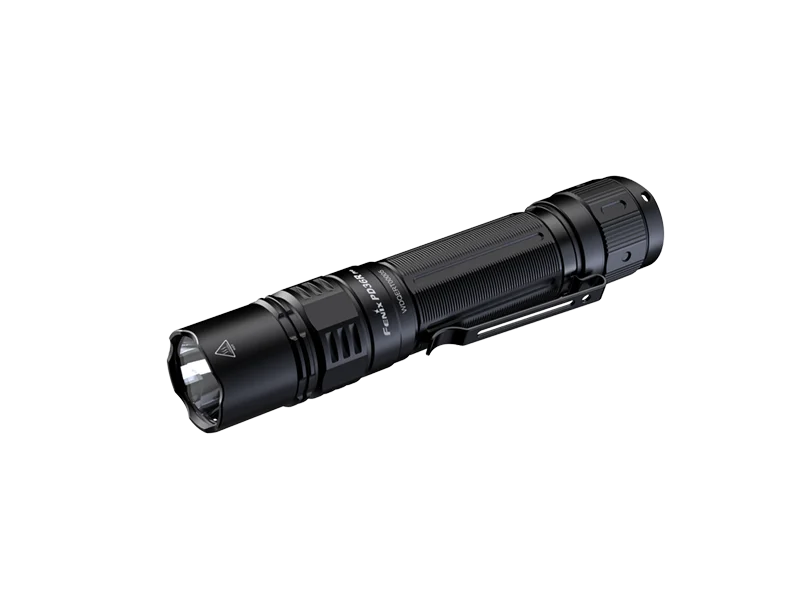
You don’t buy a tactical flashlight because it looks good in a photo. You buy it because someday, at 2 a.m., something outside your tent starts growling, or your power goes out during a storm, or you drop your keys under a truck in a parking lot with no working streetlight. In that moment, you need three things and nothing else: enough lumens to see what’s actually out there, a battery that hasn’t quietly died on you since the last charge, and a housing that survives getting knocked off a shelf, dropped on concrete, or soaked in a downpour.
That’s the checklist I run every EDC light through before it earns a spot on my belt or in my bug-out bag. Most lights fail on at least one point — they’re bright but fragile, or rugged but dim, or powerful but chew through batteries in an hour. The Fenix PD36R PRO is Fenix’s answer to a light that doesn’t force that trade-off, and after running it through daily carry, backcountry trips, and a few deliberately rough handling tests, here’s the honest breakdown of where it earns its price tag and where it falls short.
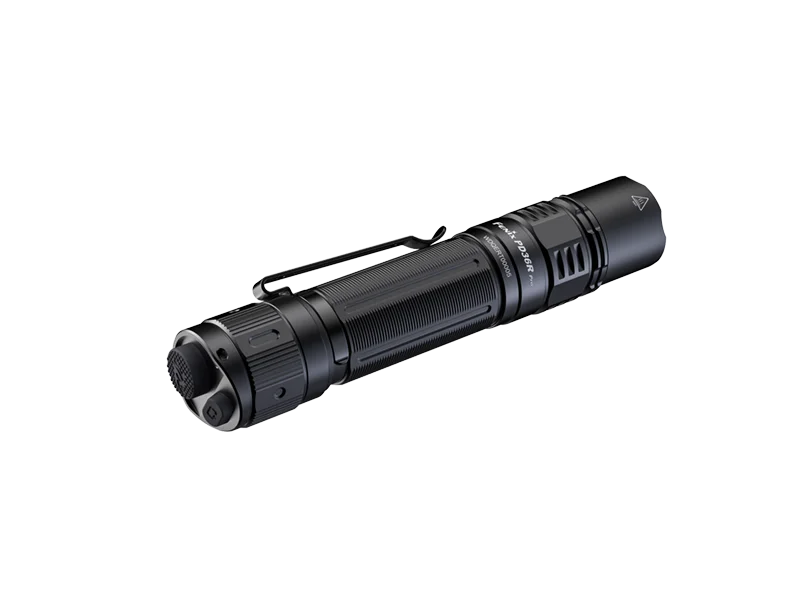
Fenix PD36R PRO: Detailed Specifications
- Max Output: 2,800 lumens (Turbo mode)
- Peak Beam Intensity: 36,600 candela
- Max Beam Distance: 380 meters (1,247 feet)
- LED: Luminus SFT70, rated for 50,000 hours
- Battery: 5,000mAh 21700 Li-ion (ARB-L21-5000), included and USB-C rechargeable
- Max Runtime: Up to 42 hours on Eco mode; roughly 3.5 hours on Turbo before automatic step-down
- Charging Time: Approximately 3 hours via USB-C (real-world testing clocks it closer to 2 hours 51 minutes at 11W)
- Lighting Modes: Five brightness levels plus strobe, controlled via dual glove-friendly tail switches
- Waterproof Rating: IP68 — dustproof and submersible to 2 meters
- Impact Resistance: Rated to 1.5-meter drops
- Body Material: A6061-T6 aircraft-grade aluminum with HAIII hard-anodized finish
- Lens: Toughened, anti-reflective coated glass
- Dimensions: 5.74″ x 1.04″ (145.8 x 25.7mm)
- Weight: 5.96 oz (169g) with battery installed
- Included Accessories: 21700 battery, USB-C cable, holster, lanyard, spare O-ring
Pros & Cons
Preppers and tactical users don’t want a sales pitch — they want to know exactly where a piece of gear will let them down before it happens in the field. Here’s the straight version.
Pros
- 2,800 lumens is genuinely more output than most people will ever need for EDC, which means you have serious headroom for search-and-rescue or self-defense scenarios
- The dual tail switch layout is intuitive enough to run blind, with gloves on, in freezing temps
- 42-hour low-mode runtime means you can realistically go a week or two of normal EDC use between charges
- HAIII hard-anodized aluminum construction holds up to repeated drops without denting the internals or cracking the lens
- IP68 rating means a light rain, a dunk in a creek crossing, or a fumble into a puddle isn’t a death sentence for this light
- USB-C charging means one cable does double duty with your phone, headlamp, or other gear — one less charger to pack
- Battery level indicator removes the guesswork on remaining charge before you head out
Cons
- Turbo mode generates real heat fast and steps itself down after roughly 3.5 minutes at full output to protect the internals — this is thermal throttling, not a defect, but don’t expect sustained 2,800-lumen output
- At 169g with the battery, it has noticeably more heft in a pocket than ultralight EDC lights — this is a trade-off for the bigger battery and brighter output, not an oversight
- The body has minimal knurling, so grip in wet or gloved conditions relies more on the tail switch geometry than the tube itself
- 70 CRI on the LED means colors under this light look slightly washed out compared to high-CRI lights — fine for tactical use, less ideal if you need accurate color rendering for detail work
- Not compatible with Fenix’s ARB-L21-6000 or ARB-L21-6000B batteries, so don’t assume every 21700 cell in your kit will drop in without checking compatibility first
Real-World Performance: How It Handles When It Actually Matters
Emergency and Low-Light Scenarios
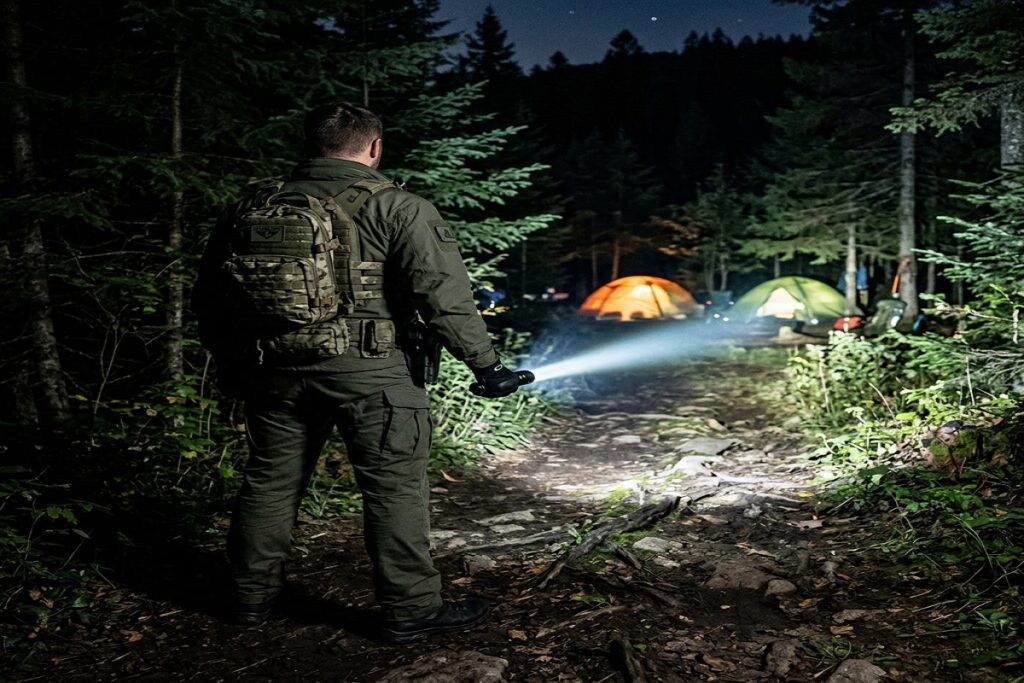
A flashlight’s real test isn’t a spec sheet — it’s what happens when you actually need it in the dark. At 380 meters of beam throw, the PD36R PRO isn’t just illuminating your immediate area; it’s giving you the ability to identify movement, terrain, or a threat well before it’s close enough to be a problem. That distance matters during a power outage when you’re checking a property perimeter, or on a night hike when you need to spot a trail marker two switchbacks ahead.
The five-mode brightness ladder is where this light earns its everyday-carry title rather than just a tactical one. You’re not stuck choosing between “too dim to be useful” and “blinding everyone in the room.” Low mode is genuinely usable for reading a map or finding something in a dark bag without destroying your night vision, while Turbo is there when you need to light up an entire yard or tree line instantly.
Self-Defense and Strobe Function
The strobe mode is instantly accessible off the secondary tail switch — no cycling through brightness levels first, no fumbling. That instant access matters more than people realize until they’ve tried operating a flashlight under stress. A disorienting, rapid-pulse strobe at 2,800 lumens is a legitimate less-lethal deterrent: it disrupts an attacker’s vision and depth perception long enough to create distance or an opening, and it does so without you needing to draw a weapon. Combined with the momentary-on function on the primary switch, you get both a controlled beam for identification and an aggressive strobe for a defensive response, without changing your grip.
Weather and Durability Testing
The IP68 rating isn’t a marketing number here — this light is internally waterproof even with the charging port cover removed, meaning a failed gasket on the port doesn’t compromise the whole unit. Between the anodized aluminum body and the 1.5-meter impact rating, dropping this off a truck tailgate onto gravel or having it take a hit during a fall on the trail isn’t a light-ending event. That’s the kind of durability margin you want in a tool you’re trusting your safety to.
Final Verdict: Is the Fenix PD36R PRO Worth Carrying?
The Fenix PD36R PRO earns its spot as one of the strongest all-around choices for everyday tactical carry in 2026. It doesn’t try to be the smallest light on the market or the cheapest — it’s built for people who need serious output, real durability, and battery life that won’t quit halfway through a long shift, camping trip, or emergency. The thermal step-down on Turbo mode and the added weight compared to ultralight options are the honest trade-offs you’re making for that performance, not flaws that should scare you off.
If your priority is a light that can handle search-and-rescue distances, take a beating, shrug off water exposure, and still fit comfortably into daily carry without babysitting the battery, the PD36R PRO belongs on your short list. For preppers and outdoor professionals who need one light to cover EDC, tactical, and emergency-prep duty without stacking three separate flashlights in a kit, this is the one that does it without compromise.
Comparison Table: Fenix PD36R PRO vs. Streamlight ProTac HL-X vs. Olight Warrior X 4
No flashlight exists in a vacuum. If you’re weighing your options before you spend, here’s how the PD36R PRO stacks up against two of the category’s most respected competitors — the Streamlight ProTac HL-X, officially issued to FBI agents, and the Olight Warrior X 4, known for its aggressive beam throw.
| Specification | Fenix PD36R PRO | Streamlight ProTac HL-X | Olight Warrior X 4 |
|---|---|---|---|
| Max Output | 2,800 lm | 1,300 lm (with SL-B26 battery) | 2,600 lm |
| Beam Distance | 380 m | 374 m | 630 m |
| Peak Beam Intensity | 36,600 cd | 35,000 cd | 99,310 cd |
| Battery | 21700 5,000mAh (included) | SL-B26 Li-ion or 2x CR123A | Custom 21700 5,000mAh (included) |
| Max Runtime (Low/Eco) | Up to 42 hours | Up to 25 hours | Up to 8 hours |
| Turbo/High Runtime | ~3.5 hours (with thermal step-down) | 1.5 hours | ~3 minutes at peak, then step-down |
| Charging | USB-C direct on the light | USB-C via SL-B26 battery | USB-C + MCC3 magnetic charging |
| Ingress Protection | IP68 (submersible to 2 m) | IPX7 (1 m for 30 min) | IPX8 (1.5 m for 30 min) |
| Impact Resistance | 1.5 m | 2 m | Not specified by manufacturer |
| Weight (with battery) | 169 g | ~162 g | Not published by manufacturer (“large size” category) |
| Approximate Price | $119.95 | Starting at $97.90 | $129.99 |
In practice, each light is playing a different game. The PD36R PRO wins on overall balance — it delivers the most runtime in Eco mode and the best ingress protection of the three without sacrificing serious lumen output. The Streamlight ProTac HL-X is the most field-proven, conservative pick: fewer lumens on paper, but it’s literally the flashlight the FBI issues its agents, which says a lot about reliability under sustained professional use. The Olight Warrior X 4 is the heavy artillery of the group — its 630-meter beam distance and nearly 100,000 candela peak intensity have no equal here, ideal for anyone who needs to identify something at long range, but that comes at the cost of noticeably shorter Turbo runtime and a higher entry price.
For the EDC tactical user who wants a single light to cover everything from daily carry to emergency response, the PD36R PRO remains the most versatile pick of the three.